Grow Lights for Indoor Plants: How to Choose One That Works
By 18300275 Canada Inc. · Published
Quick answer
For most homes, a white, full-spectrum LED is the best grow light. Match its strength to the plant: foliage houseplants need the least light, flowering houseplants and herbs need more, and seedlings and sun lovers need the most. Judge a light by its PPFD (plant-usable light at a given height), not its watts. Let a timer switch it on for 12–16 hours each day, and hang it close enough that the plants grow compact and keep their color.
Does your plant actually need a grow light?
Window light fades faster than our eyes suggest. The University of Missouri Extension notes that even low-light plants usually struggle more than about 10 feet from an average window, and Mississippi State University Extension says light can fall from roughly 1,000 to 100 foot-candles in the space of a few feet as you move back from the glass. Short winter days, a roof overhang or a sheer curtain cut it further.
Plants tell you when they are short of light. University of Minnesota Extension lists the usual signs:
- Long, thin stems with wide gaps between leaves, all leaning toward the window.
- New leaves that come in smaller or paler than older ones.
- Older leaves yellowing and dropping.
- Variegated leaves turning plain green.
- Flowering plants that grow but never bloom.
If you see two or more of these, moving the plant to a brighter window is the free fix. When there is no brighter window, a grow light is the answer.
The main types of grow light
| Type | Strengths | Drawbacks |
|---|---|---|
| LED | Most energy-efficient, long life, little heat, many shapes (bulbs, strips, bars, panels, floor lamps) | Higher price up front; a bright fixture can be glaring in a living space |
| Fluorescent tube | Cheap to buy, low heat, proven for seedlings and foliage plants | Uses more power than LED and wears out sooner; weaker at the ends of the tube |
| Incandescent | Cheapest bulb | Wastes most of its energy as heat, poor in blue light, must sit far from leaves |
| High-pressure sodium | Very bright | Hot and large; made for greenhouses, not living rooms |
This summary follows the comparison published by University of Minnesota Extension, with notes from the University of Missouri Extension, which points out that incandescent bulbs run too hot to place near plants and are short on blue light. For a home, the realistic choice is between LED and fluorescent, and most people now choose LED because it is cheaper to run and stays cool enough to hang close to leaves.
Light color and color temperature
Plants use mostly red and blue light for photosynthesis, which is why some grow lights glow purple. University of Minnesota Extension sorts grow lights into three groups by the light they give off:
- Blue or mixed: suits seedlings, leafy greens and foliage houseplants.
- Red or mixed: encourages flower buds and keeps plants shorter.
- White or balanced: suits most plants at any stage.
White light is the practical pick indoors. It grows plants well, it looks normal in a room, and it shows leaves in their true colors so you can spot yellowing or pests. A purple light makes every leaf look dark and odd, which hides early problems.
On white lights you will often see a color temperature in kelvins (K). This number describes how the light looks to people, not how much light plants get. Lower numbers, around 2700 to 3000K, look warm and yellowish like a household bulb. Higher numbers, around 5000 to 6500K, look cool and bluish like daylight. Both can grow plants. The University of Missouri Extension found that cool-white and warm-white fluorescent tubes both work fairly well, and modern white LEDs labeled for plants usually blend several colors. Choose the look you can live with, then compare brightness.
How bright: watts, lumens and PPFD
The numbers on a grow light box measure different things, and only some of them matter to a plant.
- Watts measure the electricity a light uses. Two lights with the same watts can give very different amounts of light.
- Lumens and foot-candles measure brightness as the human eye sees it. They undercount the red and blue light plants use.
- PPF (photosynthetic photon flux) is the plant-usable light the fixture puts out each second, in micromoles per second.
- PPFD (photosynthetic photon flux density) is how much of that light lands on a surface such as a leaf, in µmol/m²/s. It drops as the light moves farther away.
PPFD is the most useful figure. A good manufacturer publishes a PPFD chart showing the reading at several hanging heights and across the light's footprint, so you can see how strong the light is at the center and at the edges. If a light lists only watts or "equivalent watts," you have no way of knowing what reaches the plant.
University of Minnesota Extension gives these light ranges for each plant group, which you can compare against a PPFD chart:
| Plant group | Light level (µmol/m²/s) | Examples |
|---|---|---|
| Low light | 50–150 | Snake plant, ZZ plant, peace lily, pothos |
| Medium light | 150–250 | Ferns, spider plant, fiddle leaf fig, monstera, hoya |
| High light | 250–450 | Culinary herbs, citrus, succulents, most plants grown for flowers |
| Seedlings | 200–400 (Utah State University Extension) | Herb and vegetable starts |
These ranges are guides, not precise targets. A plant at the low end of its range will survive and grow slowly; one near the top will grow faster and fuller as long as it has enough water.
How many hours to leave the light on
Light hours and light strength work together. Growers combine them into the daily light integral (DLI), the total amount of light a plant receives in a day. You can estimate it by multiplying PPFD by the hours the light is on, then by 0.0036. A light giving 150 µmol/m²/s for 14 hours adds up to about 7.6 moles per square meter per day. The practical point is that a weaker light can partly make up for itself by running longer, within limits.
Extension sources give slightly different hour ranges, so treat these as starting points:
| Plant group | Hours per day | Source notes |
|---|---|---|
| Foliage houseplants | 12–14 | Minnesota and Mississippi State agree |
| Flowering houseplants | 14–16 | Minnesota |
| Herbs | 12–16 | Minnesota gives 12–14 for hydroponic herbs; Penn State gives 14–16 under fluorescent tubes |
| Seedlings | 12–18 | Utah State gives 12–14, Minnesota 12–16 on its seed page and 16–18 on its lighting page |
| Plants with no window light at all | 16–18 | University of Missouri; 12–14 if they also get some daylight |
Do not leave lights on around the clock. University of Illinois Extension advises no more than 16 hours for houseplants because they need a rest period, and Minnesota notes that many plants need darkness each night to develop properly. A plug-in timer is the single most useful accessory you can buy, because it keeps the schedule identical every day.
Choosing a light by plant type
Foliage houseplants
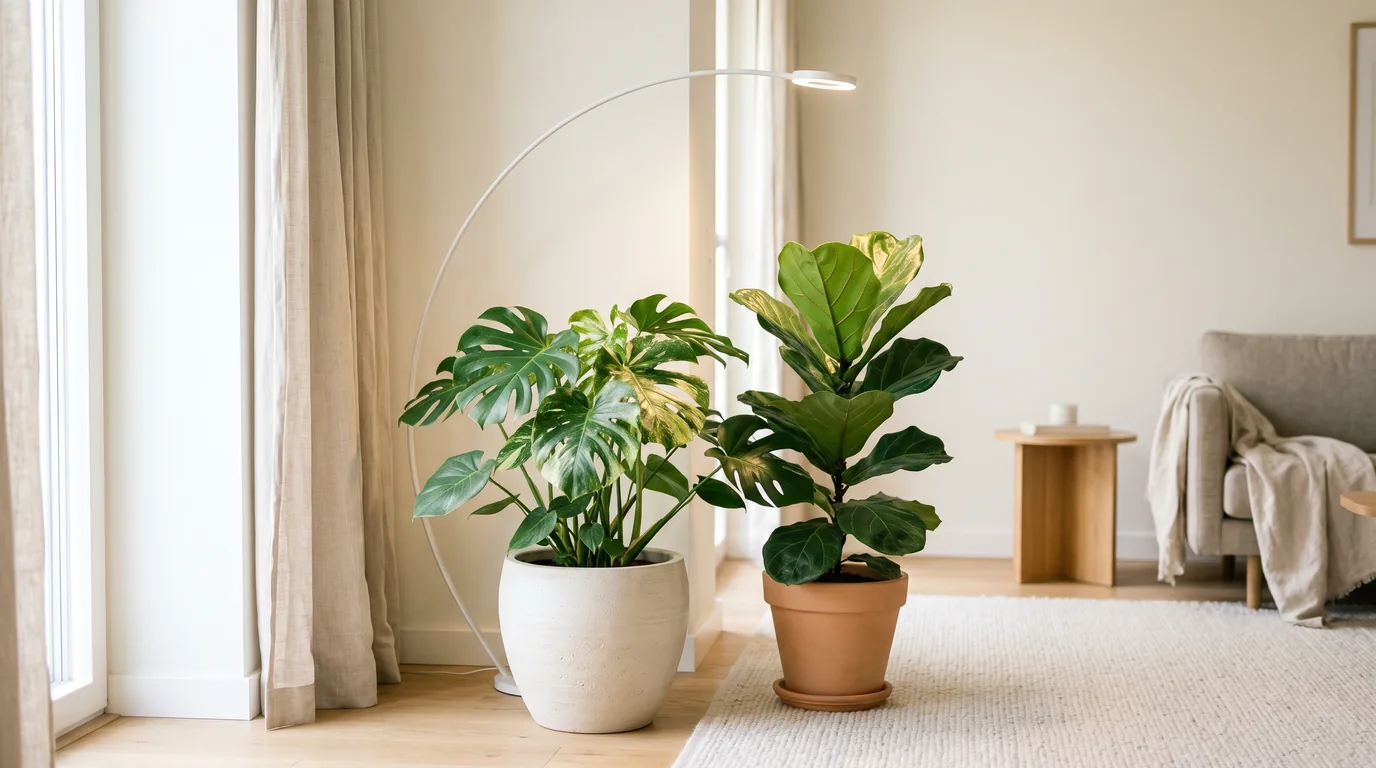
Pothos, philodendrons, snake plants and other foliage plants need the least light. A bright LED bulb in a lamp aimed at the plant, a slim LED bar under a shelf, or a floor lamp grow light like the one in the photo above will usually do. Minnesota suggests keeping foliage plants about 12 to 24 inches below the light.
Flowering houseplants
Plants grown for flowers need more light than foliage plants. African violets are among the easiest plants to bloom under lights, and the University of Wisconsin–Madison Extension recommends lights 8 to 12 inches above them with 14–16 hours of light daily. See our guides to African violet care and getting a hoya to bloom.
Herbs
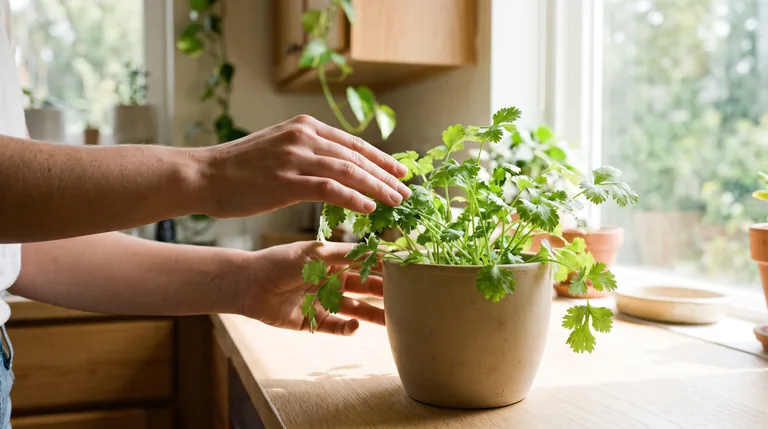
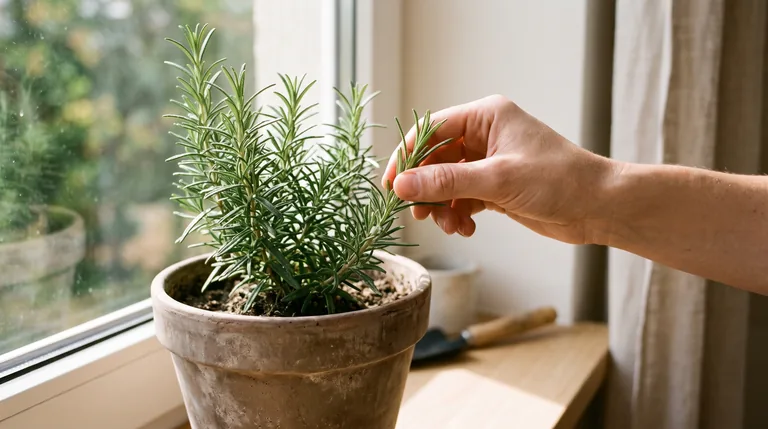
Most culinary herbs want about six hours of direct sun, which few windows deliver in winter. Penn State Extension suggests keeping herbs 6 to 12 inches below two 40-watt cool white fluorescent tubes with 14–16 hours of light daily; a modern LED bar of similar or greater output does the same job with less power. Sun lovers such as rosemary and basil need the brightest setup, while cilantro copes with a little less.
Seedlings
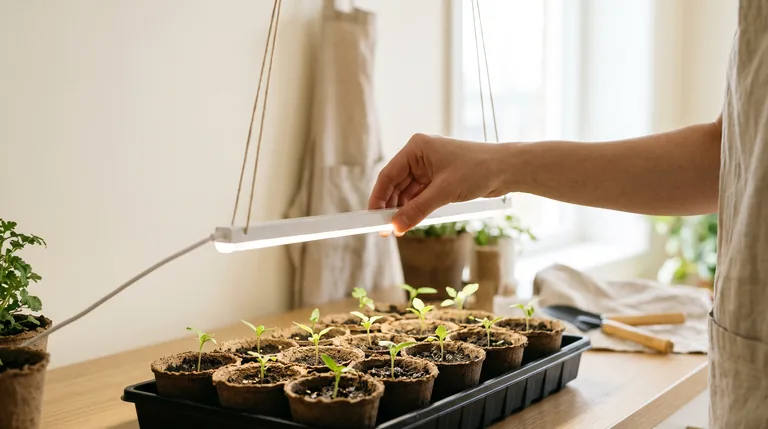
Seedlings need strong light very close to them or they stretch. Utah State University Extension says ordinary shop lights with fluorescent or LED tubes are enough, with no need for expensive grow lights. The key is hanging height, which we cover in detail in how far grow lights should be from plants.
Succulents and other sun lovers
Cacti, succulents, citrus and fruiting plants need high light. The University of Missouri Extension warns that high-light plants are the hardest to satisfy under home lighting and need the strongest fixtures. Look for a light whose PPFD chart shows readings in the high-light range at a practical height.
How to choose, step by step
- Name the plants. Put them in a group: low, medium or high light, or seedlings.
- Measure the space. Note the width and depth of the shelf or floor area you want to light, and how high the fixture can hang.
- Pick a form. Bars and strips suit shelves and seed trays; panels suit wider areas; clip lamps and floor lamps suit single plants.
- Read the PPFD chart. Check that the reading at your hanging height falls in your plants' range across the area you need, not only at the center.
- Make it adjustable. Chains, cords, an adjustable arm or a shelf you can move lets you raise the light as plants grow.
- Add a timer. Set it for the hours your plant group needs.
- Watch for two weeks. Compact, well-colored new growth means the setup works. Stretching means more light or a lower light; bleached leaves mean less.
How we compare grow lights
We do not run a test lab, and we do not claim hands-on trials of any fixture. When we compare lights, we compare published specifications such as PPFD at stated heights, coverage area, power draw and warranty, and explain what those numbers mean for your plants.
Frequently asked questions
Can a regular LED bulb work as a grow light?
For low-light foliage plants, often yes. A plant only needs enough usable light, and a bright household LED placed close to the leaves can supply it. Herbs, seedlings and flowering plants need much more intensity than a desk lamp delivers, so they usually need a fixture built for plants or a bright shop light hung close.
Is a purple (red and blue) grow light better than a white one?
Not for most homes. Red and blue are the colors plants use most, but white light that covers the whole spectrum grows plants well at every stage and lets you see the true color of the leaves. University of Minnesota Extension describes white or balanced light as suitable for most plants at any stage of growth.
How many hours a day should a grow light be on?
Most foliage houseplants do well with 12 to 14 hours. Flowering houseplants and herbs usually get 14 to 16, and seedlings 14 to 18 depending on the source. Keep it to 16 hours or less for most plants so they get a dark period, and use a plug-in timer so the schedule stays the same every day.
Do grow lights use a lot of electricity?
LED fixtures are the most efficient common option, and a small shelf light uses about as much power as a household bulb or two. The wattage printed on the label tells you the running cost. It does not tell you how much light the plants receive, which is why PPFD figures are more useful when comparing lights.
Can a grow light burn my plants?
Yes. Too much light can bleach or scorch leaves, and hot bulbs such as incandescent can dry or burn foliage held close to them. LEDs run much cooler, but a strong one hung too low can still bleach leaves. Raise the light a few inches if new leaves look washed out or crisp.
Sources
- Lighting for indoor plants and starting seeds — University of Minnesota Extension
- Houseplants: Lighting — University of Illinois Extension
- Lighting indoor houseplants (G6515) — University of Missouri Extension
- Care and selection of indoor plants — Mississippi State University Extension
- Starting vegetable seeds indoors: II. Materials — Utah State University Extension
- Starting seeds indoors — University of Minnesota Extension
- Growing herbs indoors — Penn State Extension
- Managing light in a greenhouse: daily light integral — e-GRO (Roberto Lopez, Michigan State University)
Sources last checked November 2026.