African Violet Care: How to Keep It Blooming
By 18300275 Canada Inc. · Published
Quick answer
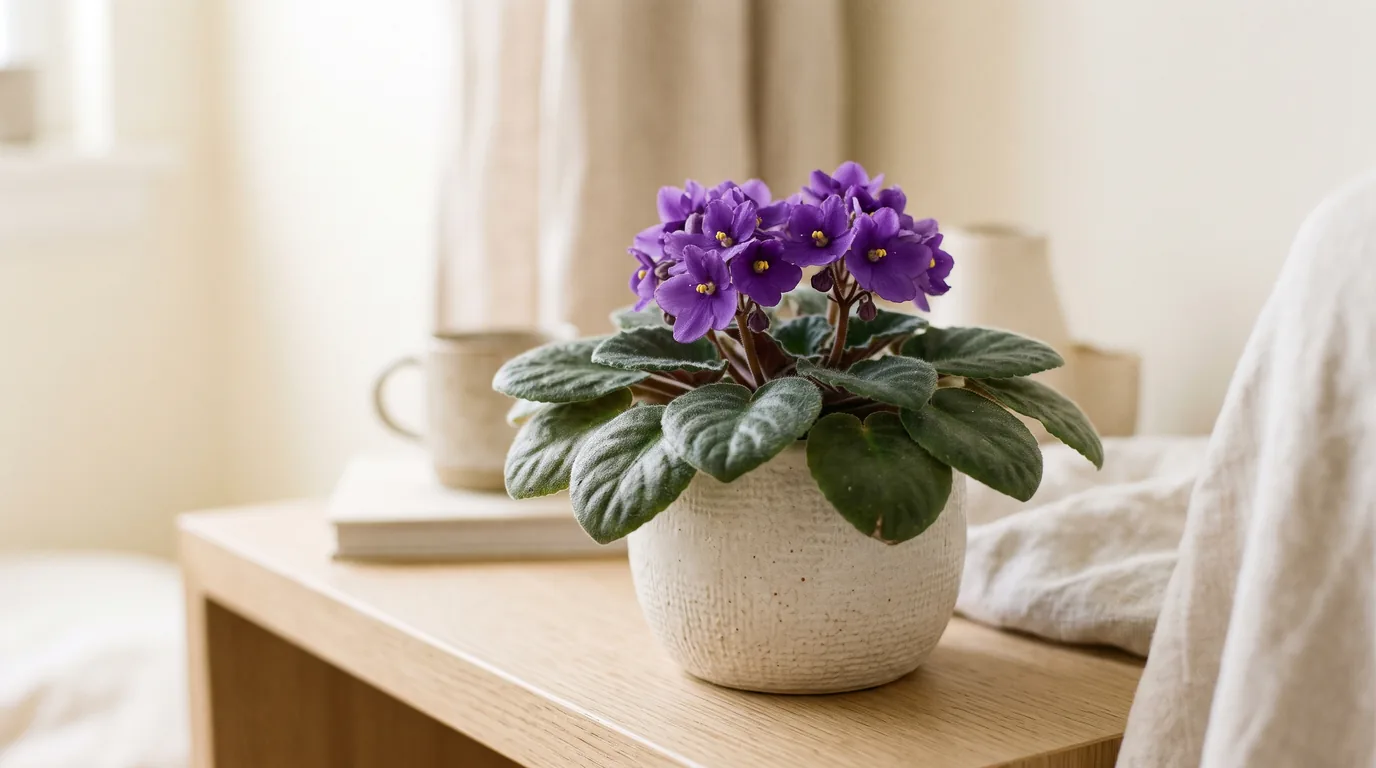
African violets bloom most of the year when they get bright, indirect light (or 14 to 16 hours under a grow light), at least 8 hours of darkness each night, and evenly moist but never soggy mix. Keep water off the leaves, use room-temperature water, grow them in a small pot so they stay slightly root-bound, and feed lightly and regularly with a fertilizer made for African violets.
A plant that can bloom almost all year
African violets (Saintpaulia) are native to Tanzania in East Africa. They form neat rosettes of fuzzy leaves with clusters of flowers in purple, blue, pink, white, maroon and two-tone combinations. University of Minnesota Extension describes them as low-maintenance plants that flower several times a year with good care, and Penn State Extension says most modern varieties bloom throughout the year without much effort.
When an African violet stops flowering, something in its care is off. The good news is that the causes are few and easy to check. This guide walks through each one, starting with the most important.
1. Light: the main reason violets stop blooming
Penn State Extension names too little light as a leading cause of poor flowering. In dim light the plant stretches, with long, narrow leaf stems, and makes few or no flowers. Too much direct sun burns the leaves instead.
Sources describe the ideal window slightly differently:
- Penn State Extension: an east-facing window is ideal, especially with a sheer curtain.
- University of Minnesota Extension: a bright, cool spot, with north, northeast or northwest windows working well.
- University of Wisconsin–Madison Extension: bright, indirect light, with protection from direct midday sun in a south or west window.
The common thread is bright light without hot direct sun on the leaves. Which window works best depends on your latitude, the season and what shades the glass, so watch the plant. Pale, bleached or yellow leaves mean too much sun; long leaf stems reaching toward the window and no buds mean too little.
Growing under lights
African violets are a classic grow-light plant, and lights are often the easiest way to keep them blooming through winter. Wisconsin Extension suggests positioning the light 8 to 12 inches above the plants with 14–16 hours of light daily. University of Minnesota Extension gives the same 14 to 16 hours for flowering houseplants. See how far grow lights should be from plants and our guide to choosing grow lights.
2. Darkness matters too
This is the step most people miss. Penn State Extension explains that African violets need light to produce the flowering signal, but the signal only triggers blooming during darkness, so they need about eight hours of dark every night. University of Minnesota Extension recommends a daily cycle of 14–16 lit hours followed by 8–10 dark ones.
So do not leave grow lights on around the clock, and do not keep a violet under a lamp that stays on late into the night. A plug-in timer makes the schedule automatic.
3. Water: evenly moist, never soggy
Watering is where most African violets go wrong. University of Minnesota Extension says root rot from overwatering is one of the most common reasons they die. Penn State Extension adds that plants that stay too dry also lose roots, and a plant with a damaged root system often stops flowering to survive. Penn State describes the target as a mix that feels like a well-wrung-out sponge.
Sources differ slightly on timing. Minnesota says keep the mix moist but not soggy; Wisconsin says let it dry slightly between waterings from spring to fall and water a little less in winter; Penn State says do not let it dry out completely. In practice: water when the surface of the mix just begins to feel dry.
Bottom watering versus top watering
University of Minnesota Extension describes three methods, all of which work if done carefully:
- From the top: use a narrow spout and water only the mix, not the leaves or the center of the plant. Gently shake or blot off any drops that land on leaves.
- From the bottom: set the pot in about an inch of room-temperature water. When the surface of the mix feels moist, take it out and let it drain. Wisconsin Extension suggests about 30 minutes of soaking, then draining off the excess.
- Wick watering: a nylon or polyester string threaded through the drainage hole draws water up from a reservoir below, keeping the mix steadily moist. This suits people who travel or forget to water.
Whichever method you use, three rules matter. Use room-temperature water, since cold water on the leaves can cause spots. Keep water out of the crown, the center where leaves emerge, because Wisconsin Extension warns African violets are highly susceptible to crown rot. And do not let the pot stand in a full saucer afterward.
University of Minnesota Extension also advises against softened water, and recommends room-temperature distilled water, rainwater or reverse-osmosis water. Wisconsin Extension suggests watering earlier in the day rather than at night.
4. A small pot and the right mix
African violets have fine roots and bloom best when slightly root-bound. Penn State Extension notes that a pot that is too big can stop flowering. The sources give different rules of thumb for pot size:
- Penn State Extension: no larger than about one-third of the plant's diameter.
- Wisconsin Extension: about half the width of the plant's spread.
For a plant 9 inches across, that means a pot of about 3 to 4½ inches. Use a pot with drainage holes and a light, well-drained, soilless mix. University of Minnesota Extension notes that packaged African violet mixes are widely available, and that some growers blend them half and half with perlite for extra drainage.
Minnesota recommends repotting in fresh mix once a year. Penn State points out that you can often clean the same pot and reuse it with fresh mix rather than moving up a size.
5. Fertilizer: little and often
Small pots hold few nutrients, so violets depend on you for food. Penn State Extension says too little fertilizer leaves the plant nothing to spend on flowers, while too much nitrogen gives lush leaves and few blooms.
- Choose a balanced fertilizer or one made for African violets. Penn State notes that the African Violet Society of America recommends avoiding fertilizers that use urea as the nitrogen source, because it can burn the roots. The label's guaranteed analysis lists the nitrogen source.
- University of Minnesota Extension suggests one-quarter of the label rate at every watering, and flushing the pot through with plain water monthly to rinse away built-up salts. Wisconsin Extension suggests a monthly feeding with an African violet fertilizer while plants are in flower, following the label.
- If the mix is dry, water with plain water first, then feed, so the fertilizer does not burn dry roots, as Minnesota advises.
6. Temperature and humidity
A comfortable room for you suits an African violet. University of Minnesota Extension gives 60 to 80°F, ideally around 70°F, and Wisconsin Extension suggests 70 to 75°F days and 60 to 65°F nights. Keep plants away from cold windows and drafts. Wisconsin warns that sudden temperature changes can harm them.
Minnesota recommends 40 to 60 percent humidity. To raise it around the plant, group violets together or set them on a tray of pebbles and water, with the pot sitting above the waterline.
7. Grooming
Pinch or snip off faded flowers and yellowing leaves. Wisconsin Extension notes this keeps the plant tidy and helps prevent gray mold. University of Minnesota Extension suggests a dry artist's paintbrush or a soft cloth for gently cleaning debris off the fuzzy leaves.
Troubleshooting
| Symptom | Likely cause | Fix |
|---|---|---|
| No flowers; long, narrow leaf stems | Too little light, and possibly too cool (Minnesota) | Brighter spot or grow light; warmer room, around 70°F by day |
| No flowers; plant looks healthy | Not enough darkness, pot too large, or feeding off balance | 8+ hours of dark; smaller pot; balanced feed at low strength |
| Pale, bleached or yellow leaves | Too much direct sun | Shift it farther from the glass, or filter the sun with a sheer curtain |
| Limp, wilted plant in wet mix | Overwatering and root rot | Repot into fresh, well-drained mix; if roots are brown and mushy, Minnesota warns the plant may not recover |
| Pale or brown spots on leaves | Water, especially cold water, on the leaves | Water at the soil or from below with room-temperature water |
| Tight centers, rusty-looking leaves | Fertilizer buildup (Minnesota) | Flush with plain water; feed every other watering |
Pets
Check the ASPCA plant toxicity database before bringing any plant into a home with cats or dogs.
Frequently asked questions
Why is my African violet not blooming?
Too little light is the most common reason. Other causes are fewer than 8 hours of darkness at night, a pot that is too big, roots damaged by over- or underwatering, and too little or too much fertilizer. Start by moving it to a brighter spot out of harsh direct sun, or put it under a grow light with 14–16 hours of light daily.
Should I water African violets from the top or bottom?
Either works if you keep water off the leaves and out of the crown. Bottom watering is the simplest way to do that: stand the pot in about an inch of room-temperature water until the surface of the mix feels moist, then let it drain. Never leave the pot sitting in water.
What causes brown or pale spots on African violet leaves?
Usually water on the leaves. University of Minnesota Extension links leaf spots to water left on the foliage, and University of Wisconsin–Madison Extension notes that cold water splashed on the leaves can cause brown spots. Water at the soil or from below, using room-temperature water.
How big a pot does an African violet need?
Smaller than you might think. They bloom best when slightly root-bound. Penn State Extension suggests a pot no more than about one-third the width of the plant, while Wisconsin Extension suggests about half. Either way, a mature standard violet usually needs only a small pot.
Can African violets grow under a grow light?
Yes, they are among the easiest flowering plants to grow under lights. Wisconsin Extension suggests lights 8 to 12 inches above the plants with 14–16 hours of light daily, and Penn State advises not running lights more than 16 hours so the plants get the darkness they need to flower.
Sources
- African violets — University of Minnesota Extension
- Why isn't my African violet flowering? — Penn State Extension
- African violets — University of Wisconsin–Madison Extension
- Lighting for indoor plants and starting seeds — University of Minnesota Extension
- Toxic and non-toxic plants — ASPCA Animal Poison Control
Sources last checked November 2026.