How Far Should Grow Lights Be From Plants?
By 18300275 Canada Inc. · Published
Quick answer
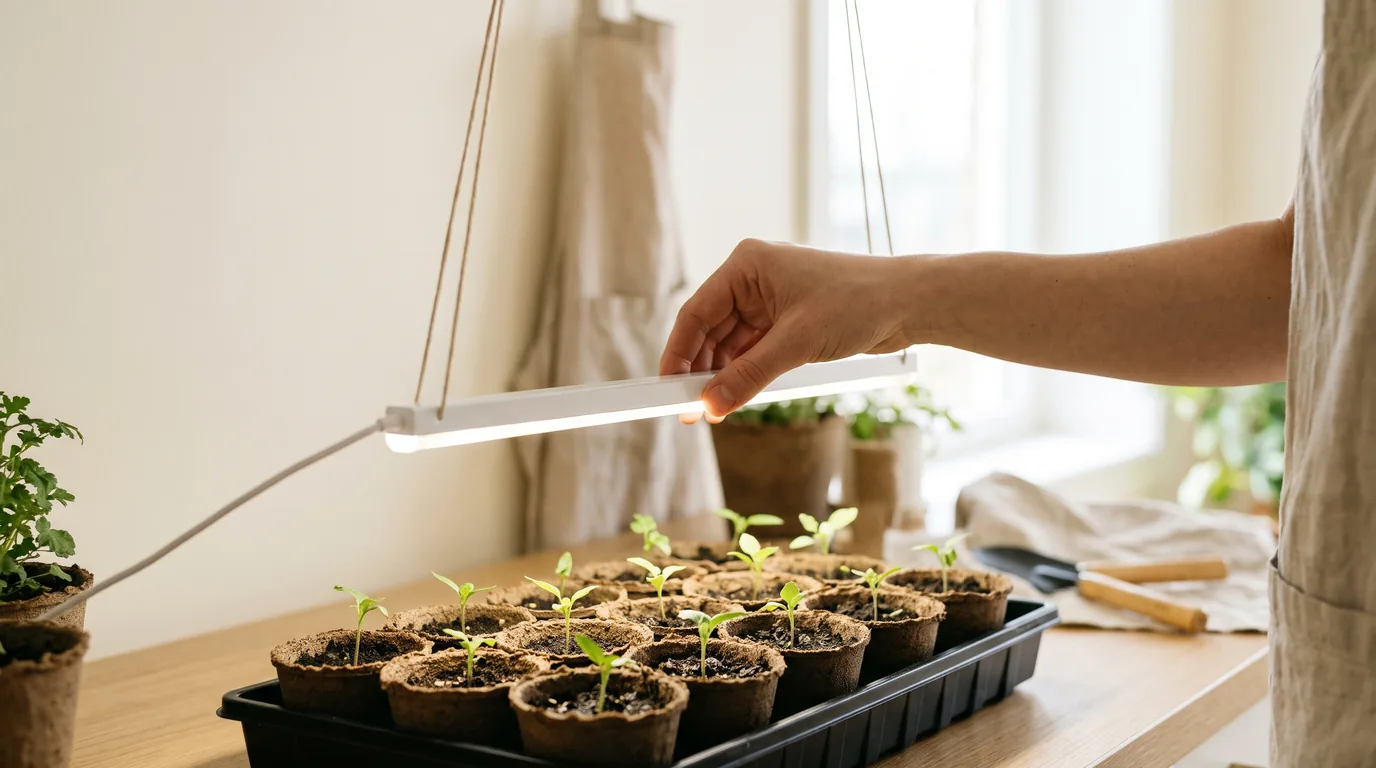
Hang the light about 2 to 6 inches above seedlings, 6 to 12 inches above herbs and flowering houseplants, and 12 to 24 inches above foliage houseplants. These figures come from extension guides that mostly assume fluorescent tubes or similar-output LEDs. With a strong LED panel, start higher, follow the maker's PPFD chart, and adjust: stretching means move it closer, bleached leaves mean move it up.
Why a few inches make a big difference
Light spreads out as it travels, so the amount reaching a leaf falls quickly as the fixture moves away. The University of Missouri Extension, which measured output below fluorescent tubes, describes intensity dropping rapidly with distance. University of Minnesota Extension makes the same point about PPFD, the measure of plant-usable light landing on a leaf: the farther the plant, the lower the number.
That is why hanging height is often the cheapest fix for a struggling plant under lights. Lowering a fixture a few inches can do more than buying a second one. It is also why a light that is too low can harm leaves, even an LED that feels cool to the touch.
Distances by plant and stage
Extension guides give these ranges. Measure from the light to the top leaves, not to the pot or the soil.
| What you are growing | Distance from light | Source |
|---|---|---|
| Seedlings | 2–4 in (2 in ideal) | University of Minnesota, seed-starting guide |
| Seedlings | 4–6 in, raised as they grow | University of Minnesota, lighting guide |
| Herbs and leafy greens | 6–12 in | University of Minnesota; Penn State (under two 40-watt fluorescent tubes) |
| Flowering houseplants | 6–12 in | University of Minnesota |
| African violets | 8–12 in | University of Wisconsin–Madison |
| Most plants under fluorescent tubes | 6–12 in to the plant tips | University of Missouri |
| Foliage houseplants | 12–24 in | University of Minnesota |
| Houseplants in general | 1–3 ft, by light need | Mississippi State University |
The sources overlap more than they disagree. The one real difference is for seedlings: University of Minnesota Extension gives "no more than 4 inches, ideally 2" on one page and "4 to 6 inches" on another. Both point the same way. Seedlings need the light much closer than most people expect, and the University of Missouri Extension likewise says to place them within a few inches of the tubes as soon as they sprout.
How the type of light changes the distance
Fluorescent tubes
Most published distances were worked out under fluorescent tubes, so the table above fits them best. The tubes run cool enough to sit a couple of inches from seedlings. The University of Missouri Extension notes that a tube is brightest at its center and weaker toward the ends, so place your neediest plants in the middle.
LED bars, strips and bulbs
LED output varies enormously from one fixture to the next. A slim under-shelf LED strip may be similar to a fluorescent tube, while a large LED panel can be several times stronger. That makes a single "LED distance" impossible to give honestly. Use the table as a starting point for low and moderate output LEDs. For a high-output fixture, check the manufacturer's PPFD chart and pick the height that puts your plants in their light range: roughly 200 to 400 µmol/m²/s for seedlings (Utah State University Extension), and about 50 to 150 for low-light, 150 to 250 for medium-light and 250 to 450 for high-light plants (University of Minnesota Extension). Our guide to choosing grow lights for indoor plants covers reading those charts.
Incandescent and other hot bulbs
Hot bulbs have to sit farther away to avoid drying or scorching leaves, and the extra distance throws away much of their light. University of Minnesota Extension singles out incandescent and high-pressure sodium bulbs as the ones where distance matters most because of heat. For a home, an LED is a better choice.
How to set the height, step by step
- Hang the light so you can move it. Chains, adjustable cords or a fixture on a stand all work. If the light is fixed, raise the plants instead on blocks, upturned pots or a shelf. The University of Missouri Extension suggests either approach.
- Start at the table distance. Pick the row that matches your plants and measure to the top leaves.
- Group plants by height and need. A single shelf works best when everything under it is about the same height and wants a similar amount of light.
- Set a timer. Distance and hours work together. A light that is a little farther away can run a little longer, up to about 16 hours for most plants.
- Check the new growth after a week or two. New leaves show the result of the change. Adjust a couple of inches at a time.
- Keep the gap as plants grow. Seedlings and herbs can grow an inch or more in a week. Raise the light to keep the same distance.
Signs the light is too far away
- Long, thin stems with big gaps between leaves. Minnesota Extension names light shortage as the chief reason seedlings turn tall and skinny.
- Stems leaning toward the light or toward a window.
- New leaves smaller or paler than older ones.
- Lower leaves yellowing and dropping.
- Variegated leaves losing their pattern, or flowering plants that refuse to bloom.
Fix: lower the light a couple of inches, or move the plant toward the center of the fixture.
Signs the light is too close
- Bleached, whitish or pale yellow patches on the top leaves while lower leaves look normal.
- Brown, crisp spots or edges on the leaves nearest the light.
- Pots under the light drying out much faster than before. Mississippi State University Extension notes that brighter light and warmer conditions make plants use more water.
Fix: raise the light 2 to 4 inches. Damaged leaves will not recover their color, so judge the result by the leaves that grow next. University of Minnesota Extension lists scorched and bleached leaves as the typical result of too much light.
A note on herbs and seedlings in the same setup
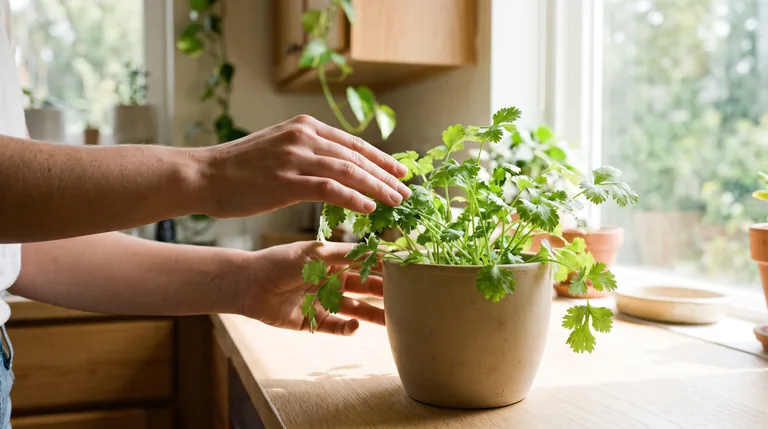
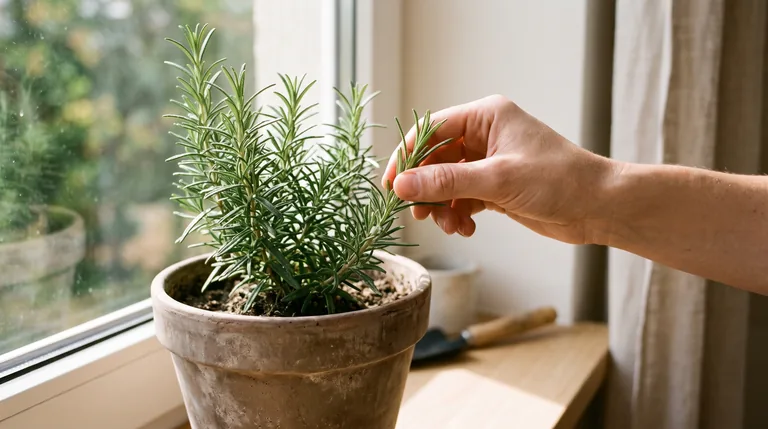
Seedlings and established herbs want different heights, which makes sharing a fixture awkward. If you must, set the light for the seedlings and lift the seed tray on a box until it is a couple of inches from the light, leaving the taller herbs below at their own distance. For more on herbs under lights, see our guides to growing cilantro and rosemary indoors.
Frequently asked questions
How high should I hang a grow light over seedlings?
Very close. University of Minnesota Extension advises no more than 4 inches above seedlings, with about 2 inches ideal, on its seed-starting page, and 4 to 6 inches on its lighting page. Raise the light as the seedlings grow to hold that small gap steady.
What distance suits houseplants under a grow light?
Foliage houseplants can sit about 12 to 24 inches below a light, according to University of Minnesota Extension. Flowering houseplants need more light, so they usually sit 6 to 12 inches away. Mississippi State University Extension gives an overall range of 1 to 3 feet depending on how much light the plant needs.
Can an LED grow light be too close to plants?
Yes. LEDs give off little heat, but a strong one can still deliver more light than leaves can handle. Bleached, pale or crisp patches on the top leaves are the warning sign. Raise the light a few inches and watch the new growth.
Why are my plants stretching under a grow light?
Stretching means the light is too far away, too weak, or on for too few hours. Lower the light first, since moving it closer raises intensity faster than anything else. If it is already close, add hours (up to about 16) or use a stronger fixture.
Does a grow light lose strength over the edges of a shelf?
Yes. Light is strongest directly beneath a fixture and weaker toward its edges, and fluorescent tubes are noticeably weaker at their ends. Put the plants that need the most light in the center and rotate pots now and then.
Sources
- Lighting for indoor plants and starting seeds — University of Minnesota Extension
- Starting seeds indoors — University of Minnesota Extension
- Lighting indoor houseplants (G6515) — University of Missouri Extension
- Care and selection of indoor plants — Mississippi State University Extension
- Growing herbs indoors — Penn State Extension
- African violets — University of Wisconsin–Madison Extension
- Starting vegetable seeds indoors: II. Materials — Utah State University Extension
Sources last checked November 2026.