How to Propagate Pothos in Water or Soil
By 18300275 Canada Inc. · Published
Quick answer
Cut a healthy vine into pieces that each carry a node (the small knob where a leaf meets the stem) plus a leaf or two. Stand the cuttings in water with the nodes submerged, or push the nodes into moist potting mix or vermiculite. Keep them warm and in bright, indirect light. Roots usually form in 3 to 4 weeks. Pot several rooted cuttings together for a full plant.
Why pothos is so easy to multiply
Pothos (Epipremnum aureum) is a climbing vine that grows small roots along its stems as it travels. Penn State Extension notes these aerial roots form at each node, the slightly swollen spot where a leaf attaches. Each node is ready-made to become a new plant, which is why a single trimmed vine can give you a jar full of cuttings.
University of Wisconsin–Madison Extension describes pothos as easily propagated from cuttings or by air layering, and Penn State lists stem cuttings, layering and division as options. This guide covers all of them, starting with the two most common: water and potting mix.
When to take cuttings
Penn State Extension says stem cuttings succeed more often during the growing season, from spring through summer. You can root pothos in fall and winter, but expect it to take longer, especially in a cool room. Wisconsin Extension notes that buds start growing in 1 to 2 weeks under warm temperatures, and that pothos grows best between 70 and 90°F, so warmth speeds things up.
Step 1: Take the cuttings
- Pick a healthy vine. Choose a stem with firm, well-colored leaves and no soft or dark patches.
- Find the nodes. Look for the small brown bumps or stubby roots on the stem opposite each leaf. Those are the nodes.
- Cut with clean, sharp scissors or pruners. Cut the vine into sections, each carrying a node and a leaf or two. A cut just below a node gives the new roots a clear place to start.
- Remove any leaf that would sit underwater or underground. Buried or submerged leaves tend to rot.
Cutting a long vine also tidies the parent plant. Penn State Extension advises trimming just above a node, and the parent will often push a new shoot from that spot.
Step 2, option A: Root in water
- Fill a clear glass or jar with room-temperature water.
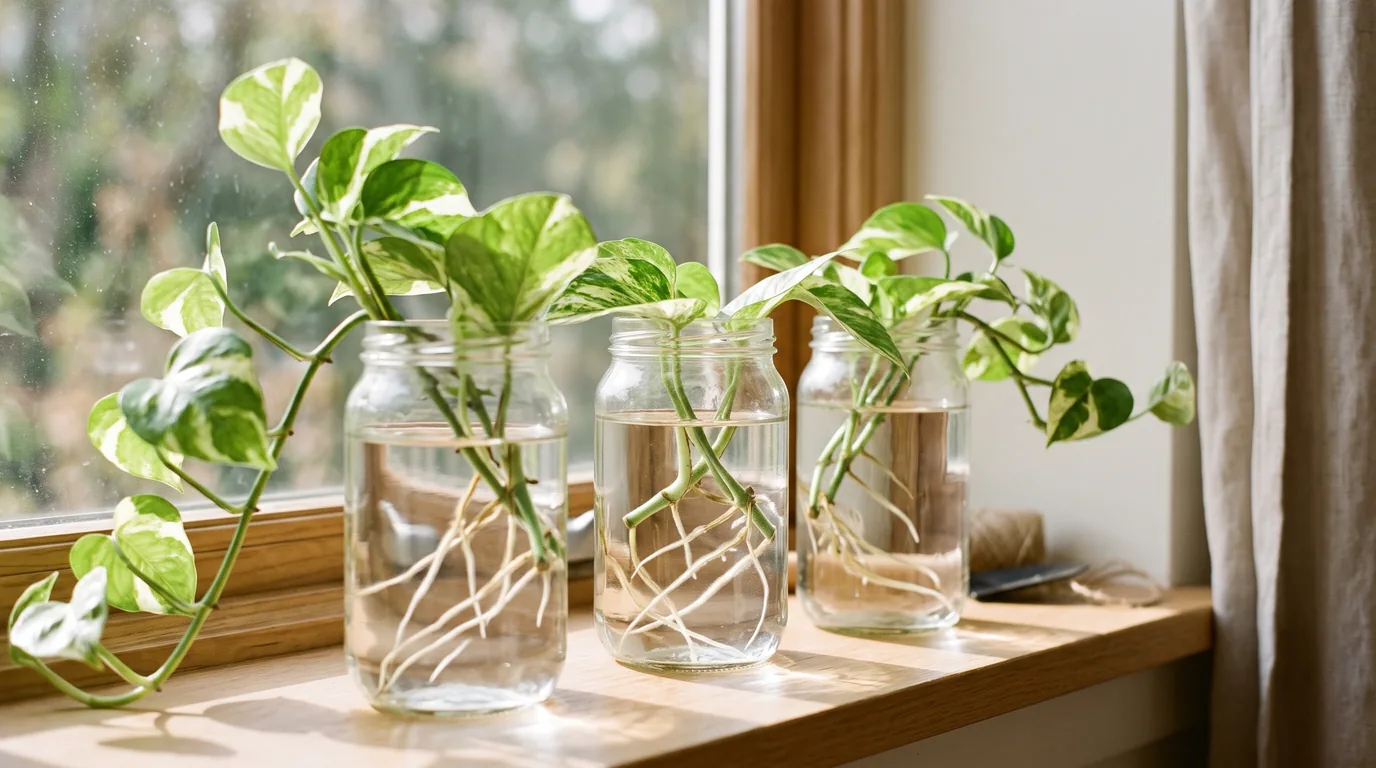
- Stand the cuttings in it so the nodes are under the water and the leaves stay above it. Several cuttings can share one jar.
- Place the jar in bright, indirect light. Penn State Extension notes that direct sun yellows pothos leaves, and a sunny sill can also warm the water too much.
- Top up the water as it evaporates, and replace it whenever it looks cloudy.
- Watch for white roots growing from the nodes. Wisconsin Extension says they typically form within 3 to 4 weeks.
Water rooting is popular because you can see progress and it is hard to get wrong. The trade-off is that roots formed in water are adapted to it, so the cutting needs a short adjustment period when it moves to soil.
Step 2, option B: Root in potting mix or vermiculite
- Fill a small, well-drained pot with moist potting mix. Wisconsin Extension says pothos roots in vermiculite as well as water, and a mix with plenty of perlite or vermiculite works well.
- Make a hole with a pencil and insert each cutting so at least one node is below the surface. Firm the mix around it.
- Water lightly and keep the mix evenly moist, but not soggy, while roots form.
- Keep the pot warm and in bright, indirect light. A clear plastic bag tented loosely over the pot holds in humidity; lift it every few days to let fresh air in.
- After 3 to 4 weeks, tug a cutting gently. Resistance means roots have formed. New leaves are another good sign.
Water or soil: which to choose
| Water | Potting mix or vermiculite | |
|---|---|---|
| See the roots | Yes | No |
| Extra step later | Move to soil once rooted | None; already potted |
| Main risk | Rot if leaves sit in water or water goes stale | Rot if kept soggy; drying out if neglected |
| Best for | Beginners and anyone who likes watching progress | Plants you plan to keep in soil |
Step 3: Pot up the rooted cuttings
Wisconsin Extension recommends planting several rooted cuttings together in one pot. A single cutting makes a thin plant; four or five in a 4- to 6-inch pot fill out much faster.
- Choose a pot with drainage holes and a good-quality soilless potting mix that drains well, as Penn State Extension advises for pothos.
- Fill the pot partway, set the cuttings in so the roots spread out, and fill around them. Keep the nodes just below the surface.
- Water until it drains from the bottom.
- Put the pot in indirect light while it settles in. Mississippi State University Extension suggests about 7 to 10 days of indirect light for any newly potted plant, warns against overwatering during this time, and advises waiting 2 to 4 weeks before fertilizing.
Cuttings moved from water may droop for a few days as they adjust. Keep the mix lightly moist during that first week or two, then switch to normal care.
Other ways to propagate pothos
Layering
Penn State Extension notes that because pothos has aerial roots at its nodes, layering works well. Set a small pot of moist mix next to the parent plant, lay a vine across it and pin a node to the surface with a bent paper clip or hairpin. Once that node has rooted, cut the vine from the parent. The new plant never loses its water supply while rooting, which makes this one of the most reliable methods.
Division
Penn State Extension suggests dividing a large pothos during its yearly repotting. A pot that started as several cuttings can be teased apart into smaller clumps, each with its own roots and stems.
Air layering
Wisconsin Extension also mentions air layering, which roots a section of stem while it is still attached, usually by wrapping a node in moist moss. With pothos, simple layering into a pot is easier and gives the same result.
Caring for the new plant
- Light: bright, indirect light gives the fastest growth and the strongest variegation. University of Illinois Extension notes pothos tolerates very low light, but Wisconsin Extension says low light can cause variegated types to lose their pattern.
- Water: wait until the surface of the mix feels dry, then water. Penn State Extension says pothos is better kept a little too dry than too wet, and overwatering leading to root rot is one of its few problems.
- Temperature: Penn State gives 60 to 80°F as a good range. Keep it away from cold drafts.
- Shape: pinch or trim long vines just above a node to encourage branching, and root the trimmings to make the pot fuller.
Troubleshooting
| Problem | Likely cause | Fix |
|---|---|---|
| No roots after 5 or 6 weeks | No node on the cutting, or too cold | Check for a node; move somewhere warmer |
| Stem turning brown and mushy | Rot, caused by old water or soggy mix | Cut above the rot, refresh water or let mix dry slightly |
| Leaves yellowing on the cutting | Direct sun, or the cutting using its stored energy | Move to indirect light; losing an older leaf can be normal |
| Thin, sparse new plant | Too few cuttings in the pot, or low light | Add more rooted cuttings; give brighter indirect light |
Safety
Penn State Extension notes that all parts of pothos contain calcium oxalate crystals, which irritate the mouth, digestive tract and skin of people and pets. Wear gloves if your skin is sensitive, wash your hands after taking cuttings, and place jars of cuttings where children and pets cannot get at them. Check the ASPCA plant toxicity database for details.
Frequently asked questions
Can a pothos leaf without a node grow roots?
A single leaf with no piece of stem may root, but it will not grow into a new plant, because new shoots grow from the bud found at a node. Always keep at least one node, the bump on the stem where a leaf and an aerial root meet.
How long do pothos cuttings take to root?
University of Wisconsin–Madison Extension reports roots in water or vermiculite after 3–4 weeks, and new buds after 1–2 weeks if conditions are warm. Cool rooms and winter months slow both down.
Is it better to root pothos in water or soil?
Either method succeeds. Rooting in a jar shows you the progress and is very forgiving. Rooting directly in mix skips the transplant step, so the plant does not have to adjust from water roots to soil. If you plan to keep the plant in soil, rooting in a moist mix or vermiculite is slightly less disruptive.
Can pothos live in water permanently?
Cuttings can stay in water for a long time, but growth is usually slower than in potting mix because plain water holds few nutrients. For a full, fast-growing plant, move rooted cuttings into a pot.
Why is my pothos cutting rotting in water?
Usually because leaves are sitting in the water, the water has gone stale, or the cutting was taken from a weak or damaged stem. Trim off soft parts above the rot, remove any submerged leaves, use fresh water and a clean jar, then give it warmth and bright light without direct sun.
Sources
- Pothos as a houseplant — Penn State Extension
- Pothos, Epipremnum aureum — University of Wisconsin–Madison Extension
- Trailing houseplants — University of Illinois Extension
- Care and selection of indoor plants — Mississippi State University Extension
- Lighting for indoor plants and starting seeds — University of Minnesota Extension
- Toxic and non-toxic plants — ASPCA Animal Poison Control
Sources last checked November 2026.